
You Can Get Just About Anywhere Except Home - The 26-Hour Day
Iberico ham, delayed flights, beer, and twenty-six hours of increasingly poor decisions

Part 1: The T-Shirt Problem
At 01:53 in the morning I was standing in my kitchen staring at a t-shirt, which isn’t how most journeys begin unless something has already gone slightly wrong. The shirt itself wasn’t the problem. The problem was that in roughly eight hours I would be standing in Valencia photographing boats in twenty-six degree sunshine, while at that exact moment I was standing barefoot in a dark Hampshire kitchen wondering whether Britain had quietly become the North Atlantic overnight. Nobody really talks about this part of travel. The brochures are full of smiling couples drinking wine in sunlight and suspiciously attractive people leaning against boats they clearly don’t own, but nobody addresses the genuinely difficult question of how you’re supposed to dress for two countries at the same time. For approximately eighteen hours I would be in Spain. For approximately two hours I would be suffering Britain. The ratio felt unfair. Too warm and I’d spend the airport sweating before sunrise. Too cold and I’d arrive in Valencia dressed like a man expecting to inspect a trawler off Greenland. Eventually I selected clothing using the same rigorous decision-making process normally employed by gamblers, pirates, and people attempting DIY electrical work after two beers. Close enough.
The coffee wasn’t helping. It sat there on the kitchen counter looking both essential and vaguely threatening, which is always how the first coffee of the day behaves. Beside it was a protein bar. I don’t trust protein bars. Nobody actually likes protein bars. They exist in the same category as survival rations and tax returns. Nobody reaches for one because they’re excited. They reach for one because they’re trying to prevent themselves dying before lunch. Outside the windows the world remained entirely sensible and asleep. Inside I was preparing to leave the house at a time normally reserved for burglars, foxes, fishermen, and people making increasingly expensive mistakes on the internet. The whole thing already felt faintly ridiculous. Twenty-six hours of travel. Six hours of work. Two boats. Hundreds of photographs. An amount of logistics that would have concerned a small military operation.
The taxi arrived at 02:30 and suddenly it was all happening. Camera bag loaded. Batteries checked. Lenses cleaned. Enough equipment packed to either photograph luxury yachts or document a minor coup depending on how the day developed. The roads were almost empty. Streetlights reflected on wet tarmac. The New Forest drifted past outside the window looking half asleep and entirely unconvinced by my plans. There is something deeply unnatural about travelling at that hour. The motorway feels borrowed. The service stations look haunted. Every other vehicle appears to belong either to somebody going fishing or somebody disposing of evidence. Meanwhile I sat in the back clutching a coffee and trying to remember whether I’d actually slept or merely closed my eyes for a while and hoped for the best.

Gatwick arrived sometime around half past four. Airports before dawn are their own ecosystem entirely. Nobody is there because they want to be. Everyone is carrying something. Everyone is tired. Everyone moves with the same strange determination usually associated with migrating animals. Families dragged children through terminals like reluctant luggage. Business travellers stared blankly into phones. Somebody was already drinking a pint. Somewhere else somebody was asleep on the floor. Humanity at its finest. Humanity at its absolute worst. Humanity held together entirely by caffeine and departure boards. The beautiful thing about travelling with only hand luggage is the illusion of efficiency. The terrible thing about travelling with only hand luggage is that every possession you own immediately becomes your responsibility. Two Sony A1s. Five lenses. GoPros. Batteries. Cards. Cleaning kit. Everything hanging from my shoulders while I shuffled through security carrying what felt increasingly like a collapsed satellite.
Security, surprisingly, was painless. This immediately worried me. Airport security usually behaves as though every passenger is moments away from attempting something spectacularly stupid. Normally somebody wants to inspect something, question something, confiscate something, or at the very least look suspiciously at your camera bag. This time they simply waved me through. I can only assume I looked too exhausted to represent a credible threat. Eventually I found myself at the gate with time to spare, which meant enough time to buy a bottle of water. This detail is important. Remember the water. The water is one of the main characters in this story. At the time it was just a bottle of water. A practical purchase. Hydration. Sensible planning. A tiny victory against dehydration and poor decision-making. What I didn’t realise was that the water and I were about to begin a complicated long-distance relationship.
The flight itself was uneventful, which is disappointing because uneventful flights rarely make good stories. Nobody wants to hear about a smooth journey. Nobody gathers around in a pub to hear tales of competent logistics and efficient scheduling. So instead I’ll tell you about the water. The water sat beside me the entire flight. Loyal and dependable. Patient. Everything you’d hope for from a bottle of water. We crossed Europe together. We looked out the window together. We approached Spain together. And then, immediately upon landing, I abandoned it without a second thought. Walked straight off the aircraft. Through the terminal. Through arrivals. Through customs. Into Valencia itself. It wasn’t until much later that I realised somewhere aboard an EasyJet aircraft sat a bottle of water wondering where I’d gone. It had travelled hundreds of miles only to be left behind at the exact moment it was needed most. In hindsight this was probably an omen. A warning. A sign from the universe that hydration and I would not be spending much time together over the next twenty-four hours. Naturally, I ignored it completely.
Because Spain was waiting.
And things were about to become considerably stranger.
Part 2: Valencia
Valencia greeted me with sunlight, confusion, and an immediate reminder that my Spanish remains absolutely terrible.
I had landed successfully, which felt like a reasonable start, but the first challenge arrived shortly afterwards in the form of a taxi driver and a conversation that neither of us were remotely qualified to have. She spoke no English. I spoke the sort of Spanish normally acquired by accidentally ordering beer on holiday and then never progressing beyond that stage. Between us we probably possessed half a functioning language. I showed her the marina address. She looked uncertain. I showed her Google Maps. She looked more uncertain. At one point she phoned somebody. Then somebody else. Eventually I found myself leaning between the seats, taking possession of her phone and entering the destination myself while she watched with the expression of somebody witnessing a hostage situation unfold in slow motion.
To be fair, I wasn’t entirely convinced we were going to the right place either.
Eventually the city gave way to marinas, cranes, masts and water. The sea appeared in flashes between buildings. Palm trees swayed lazily in the heat. Everything looked effortlessly Mediterranean while I stood there carrying several thousand pounds worth of camera equipment and slowly cooking inside my own clothing.
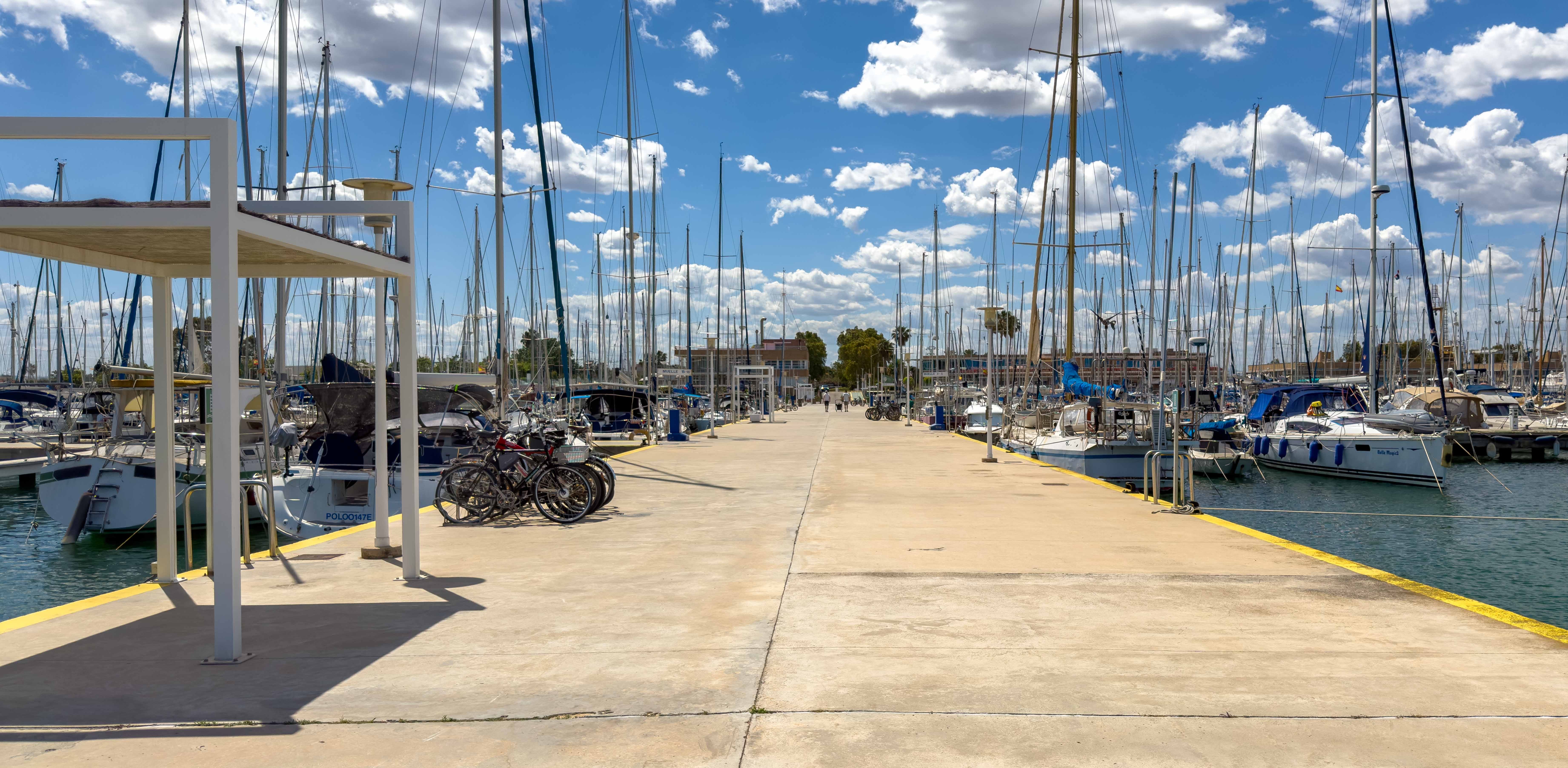
The first marina felt alive in that particular way marinas always do. Somebody was washing a boat. Somebody was fixing something. Somebody was carrying rope. Somebody was arguing about something that almost certainly involved a boat. The universal language of marinas is mild inconvenience. It doesn’t matter whether you’re in Southampton, Valencia, Auckland or Antigua. Somewhere nearby, somebody is trying to solve a problem involving water, money, batteries, engines, or all four simultaneously.
The boat was waiting where it was supposed to be, which was already a pleasant surprise. The girl looking after it was running around preparing everything before I arrived. Cushions were being arranged. Decks wiped down. Lines coiled neatly. The invisible work that makes photographs look effortless afterwards. People see the final images and imagine the boat simply existed that way naturally, as though luxury yachts spontaneously arrange themselves into perfection whenever a camera approaches. In reality there’s usually somebody sweating quietly behind the scenes making sure the photographer doesn’t have to spend forty minutes moving a bucket.
She’d lived in Valencia her entire life. Her family was there. She knew everyone, knew every marina, every corner of the city, every shortcut. The sort of local knowledge you can never learn from maps. We chatted while I unpacked cameras and started working. It was one of those strange travel interactions where you know you’re probably never going to spend much time together, yet somehow end up discussing enough life to fill a train journey.
The boat itself was beautiful. Discovery yachts generally are. They occupy that dangerous category of boat that can make sensible people begin calculating how much money they don’t have. Everything feels deliberate. Thought through. Built by people who understand that crossing an ocean comfortably is still crossing an ocean. I moved through the usual routine. Interiors first. Details. Wide shots. Cabins. Saloon. Galley. Exterior angles. Hero shots. Drone. The process becomes strangely automatic after enough years. Half technical exercise. Half treasure hunt. You’re constantly looking for the image nobody else has noticed yet.
The thing people never see is how much walking photography involves. Photography is mostly sold as a glamorous activity performed by mysterious artists bathed in perfect light. In reality it’s often just wandering around repeatedly while carrying heavy things and muttering to yourself. I must have walked every inch of that boat several times over. Up. Down. Forward. Back. Wide lens. Telephoto. Back again because I forgot something. Then once more because I remembered something else.
By the time I finished the first boat, the heat had properly arrived.
Now, thirty-six degrees doesn’t sound particularly dramatic written down. British people hear thirty degrees and immediately begin discussing barbecues and regrettable shorts. But there is a difference between thirty-six degrees at home and thirty-six degrees standing on white decks surrounded by reflective water while carrying cameras. Everything radiates heat. The pontoons radiate heat. The stainless steel radiates heat. The boats radiate heat. The sea itself seems to radiate heat out of spite.
My carefully calculated hydration strategy had already begun to unravel.
Partly because I had abandoned my original bottle of water somewhere over Europe.
Partly because I am apparently incapable of learning from previous mistakes.
Partly because photographers have a remarkable ability to ignore basic biological requirements while pursuing images.
At some point you stop noticing thirst. Then you stop noticing common sense. Then eventually you find yourself photographing deck hardware while wondering why your brain feels wrapped in cotton wool.
My original plan involved walking to the next marina. Technically this remained possible. Maps claimed it was perfectly reasonable. Maps also claim many things. Maps have never carried three cameras in direct sunlight while questioning their relationship with hydration.
Fortunately she offered me a lift.
The seat was wet.
She apologised immediately.
Water had spilled.
Which was ironic given my own increasingly complicated relationship with water by this point.
We laughed about it and headed across Valencia. It wasn’t a long drive. Fifteen minutes, maybe twenty. Long enough for her to apologise several more times for the water on the seat. Long enough to talk about the city, the weather, the boats, and the fact she’d lived there her entire life. Family there. Friends there. Leaving next week. Back again after that. The sort of conversation travellers have all over the world every day. Brief, friendly, and entirely unremarkable until years later when you realise it’s the thing you remember most clearly.
It should probably be noted that she was also absolutely gorgeous, which may have contributed slightly to how vividly the conversation has lodged itself in my memory. Not entirely. I’m shallow, not completely useless. She was funny, kind, clearly working harder than I was, and had the sort of easy confidence that comes from actually belonging somewhere. Before I got out of the car she handed me her number and told me that next time I was in Valencia I should call and she’d collect me from the airport. I said I would. And I probably will.
That’s one of the strange things about travelling for work. The places blur surprisingly quickly. Airports disappear almost immediately. Hotel rooms evaporate from memory within days. Even the boats eventually merge into one long collection of teak decks and polished stainless steel. But people linger. Years from now I probably won’t remember exactly which berth that boat was tied up on. I’ll remember the woman who rescued a sweaty photographer from a half-hour walk across Valencia and apologised repeatedly for a patch of water on a seat nobody cared about.
Bob, naturally, interpreted the entire encounter as the opening chapter of a Mediterranean romance. This is one of many reasons he is not permitted to make strategic decisions.
I messaged her later.
Mostly because she had saved me from a very hot walk carrying camera gear.
Partly because it seemed rude not to.
The second marina felt different immediately. Less polished. More working yard. More practical. More containers. More machinery. The sort of place where things happen rather than where people take photographs pretending things happen.
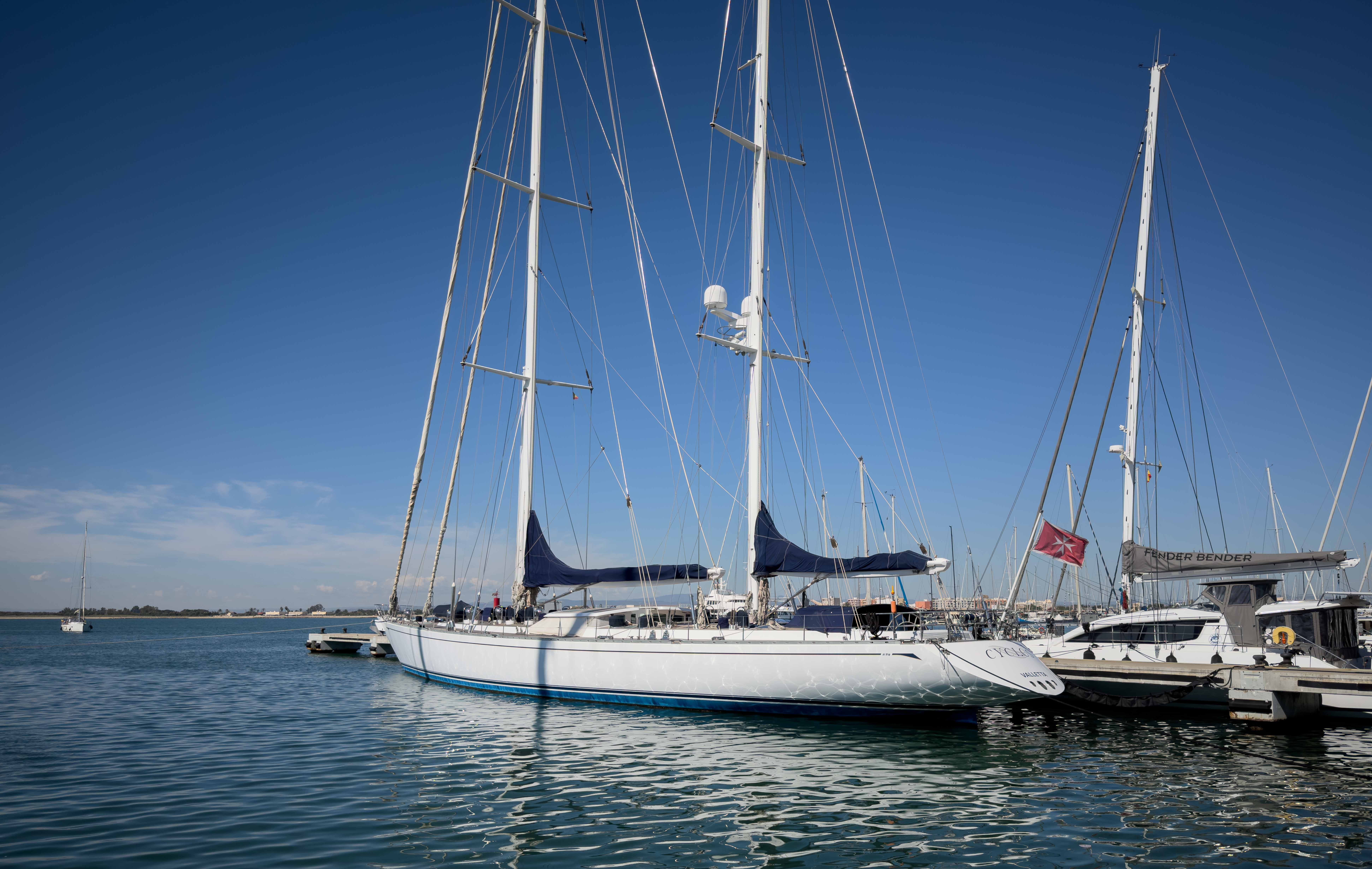
The next challenge was locating the keys.
Nobody seemed entirely certain who had them.
Or where they were.
Or whether they currently existed in a state accessible to humanity.
I was directed towards an office.
The office turned out to be a shipping container.
Which somehow made perfect sense.
Important things are always hidden inside shipping containers.
I found the container man sitting inside surrounded by paperwork, equipment, tools and the general atmosphere of somebody who spends most of his life solving problems other people accidentally create.
Most importantly, he had the keys.
Of course he did.
We chatted for a while. A conversation that starts with boats and somehow ends up covering weather, travel, work, and life in general. The universal marina conversation. Before I left, we agreed to meet later for a beer once I’d finished shooting.
This seemed like an excellent plan.
I photographed the second boat.
More cabins.
More details.
More walking.
More sweating.
By this point the day had settled into that strange rhythm familiar to anyone who works on location. You stop paying attention to time. The only things that matter are the next shot, the next angle, the next problem to solve. Hours disappear without warning. One moment you’re setting up. The next moment you’re packing everything away wondering where the afternoon went.
The heat remained relentless.
Not unbearable.
Just persistent.
A heat that slowly extracts energy while pretending to be pleasant.
Every metal fitting was warm to the touch. Every deck reflected sunlight upward with active hostility. My shirt had become progressively less shirt-like and more an elaborate salt collection system. Somewhere in the distance somebody was running an angle grinder. Somewhere else somebody was laughing. The smell of diesel drifted across the marina. Seagulls conducted their usual quality control inspections from nearby rooftops.
Eventually the work was finished.
The files were safe.
The cameras packed away.
The pressure gone.
Which meant it was finally time for the important part of the day.
Beer.
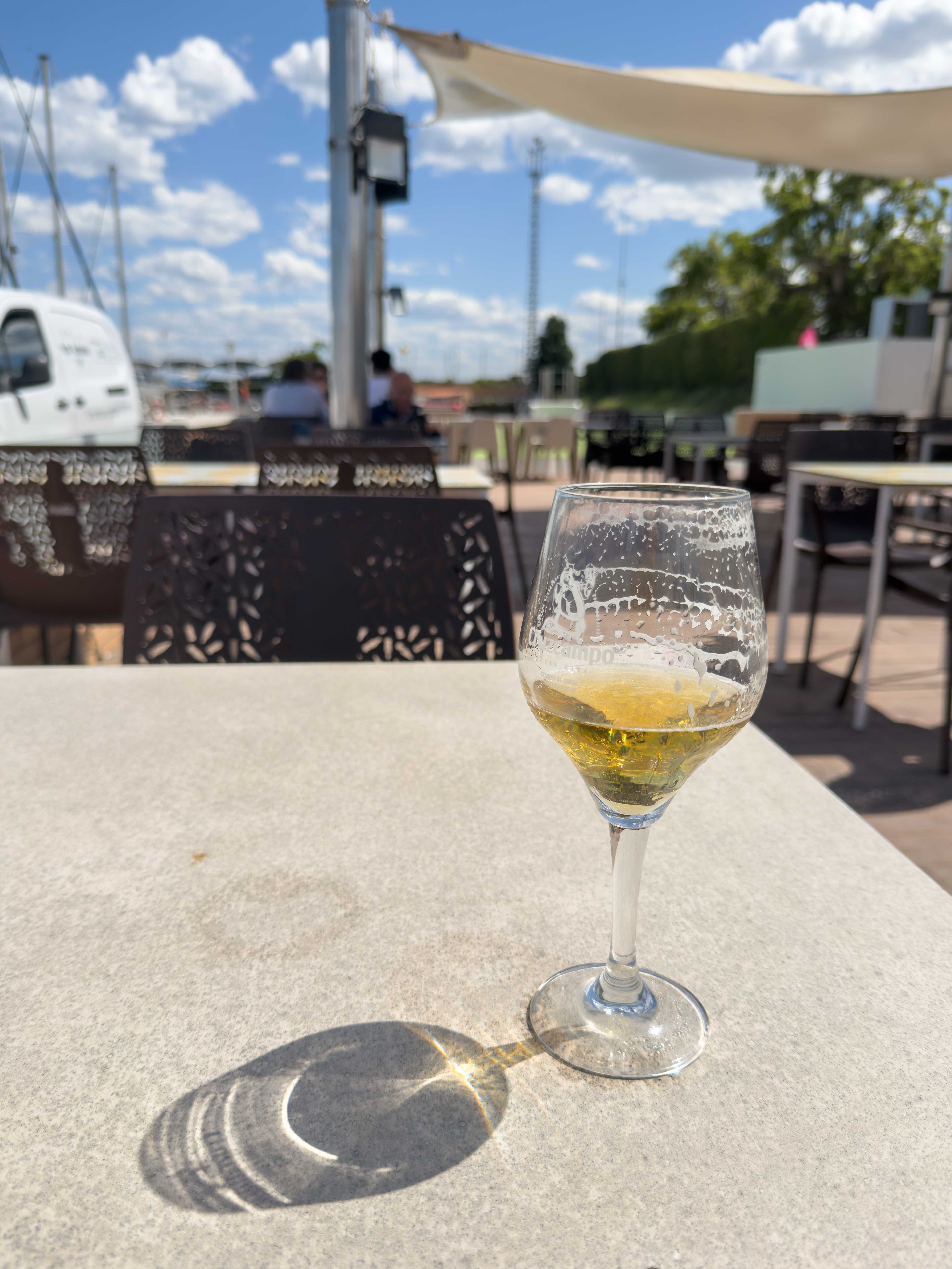
I found the container man exactly where he said he’d be. Him and his team were already sitting outside with drinks. Somebody immediately handed me one. Marina hospitality is wonderfully straightforward. Nobody asks complicated questions. Nobody needs networking opportunities. Nobody wants to discuss personal branding. You sit down. You drink a beer. You talk rubbish.
The team spoke about boats, work, Valencia, travel and everything else that drifts naturally into conversation after a long day. We sat there watching the afternoon settle across the marina. Masts swaying gently. Rigging clinking in the breeze. Forklifts moving somewhere in the distance. The heat finally beginning to loosen its grip.
It’s one of my favourite parts of travelling.
Not the flights.
Not the airports.
Not even the boats.
The people.
The random people you meet for a few hours and may never see again.
The woman cleaning the first boat.
The container man.
His team.
The taxi driver who survived my navigation assistance.
All these brief intersections that appear for a moment and then disappear again.
At some point I realised I’d travelled hundreds of miles, crossed a national border, survived airport security, negotiated with a taxi driver using interpretive Google Maps, carried several thousand pounds worth of camera equipment through two marinas and spent most of the afternoon slowly dehydrating on pontoons, all to create photographs people will likely look at for somewhere between three and six seconds before scrolling onward. Photography is occasionally a strange profession. You spend extraordinary amounts of effort creating things that appear effortless afterwards. If you’ve done the job correctly nobody notices the job at all.
By the time I stood up to leave, the sun was lower, the cameras were safely packed away, and the work was done.
I had photographed the boats.
Found the keys.
Survived the heat.
Made new friends.
And still had absolutely no idea that the most ridiculous part of the trip was waiting for me at the airport in the form of an entire leg of Iberico ham.
Part 3: Ham
I arrived at Valencia Airport feeling surprisingly pleased with myself.
The boats had been photographed. The cameras were still functioning. Nobody had fallen overboard. The files existed in at least three separate places. The day had been productive, efficient even, which should have been my first warning sign. Travel has a habit of maintaining a rough balance. If one part of the journey goes suspiciously well, something else is usually waiting patiently around the corner with a chair and a baseball bat.
At first everything seemed normal enough.
I checked in.
Found security.
Removed various items from my pockets.
Then immediately got told off for wearing flip-flops.
Not verbally, exactly. More through that special look airport security staff develop after years of witnessing humanity’s finest ideas.
Apparently the flip-flops needed additional inspection.
I still don’t fully understand why.
Perhaps they suspected I was smuggling a knife under my toes.
Perhaps they suspected I was smuggling several knives…
Perhaps somebody, somewhere, once attempted to hijack an aircraft using beach footwear and now we’re all paying the price.
Regardless, I found myself standing barefoot in an airport while a man examined my flip-flops with the seriousness normally reserved for unexploded ordnance.
They were eventually declared safe.
Civilisation survived.
I continued onward.
The airport itself was pleasant enough. Bright. Clean. Air conditioned. Full of people heading somewhere else. That’s the thing about airports. Nobody belongs there. They’re giant expensive waiting rooms filled with temporary lives. Everyone is either leaving, arriving, escaping, returning, beginning something, ending something, or avoiding somebody. Nobody ever wakes up and thinks:
“You know what I’d love today? Six uninterrupted hours in an airport.”
I wandered.
I always wander.
I don’t understand people who find a gate and remain there for three hours like decorative furniture. Airports are strange little ecosystems. You have to explore them. Every terminal contains its own species of traveller. Families attempting crowd control. Businessmen moving with exaggerated urgency. Backpackers sleeping in positions that would require medical attention if attempted by anyone over thirty. Couples arguing quietly over logistics. Children somehow operating at three hundred percent energy despite having consumed nothing but sugar and spite.
And then I found the ham.
Not ham in the ordinary sense.
Not slices.
Not a sandwich.
Not even a particularly large sandwich.
An entire leg.
A complete Iberico ham.
Hoof attached.
The full animal commitment.
Hanging proudly in a display cabinet like a medieval relic.
Three hundred and sixty euros.
I stood staring at it for an amount of time that became increasingly difficult to justify.
Bob was immediately in favour of purchasing the ham. Bob has never once demonstrated financial restraint, practical judgement, or any understanding of international customs regulations. He is, after all, a moth.
The problem wasn’t the price.
Well, it was partly the price.
But mainly it was the idea.
I liked the idea.
The practical side of my brain immediately pointed out that I was about to board an EasyJet flight carrying only hand luggage. The practical side of my brain also pointed out that an eight-kilogram pig leg is not generally considered a travel essential.
The other side of my brain, however, was already imagining it.
Walking onto the aircraft carrying an entire leg.
Trying to fit it in the overhead locker.
Explaining it to customs.
Explaining it to the taxi driver.
Explaining it to my neighbours.
Explaining it to myself several days later.
There was something wonderfully ridiculous about the whole concept.
Most people return from Spain with a fridge magnet.
I was considering returning with approximately quarter of a pig.
For a while I genuinely entertained the possibility.
I walked away.
Returned.
Walked away again.
Came back for another look.
The ham remained where it was.
Patient yet confident. Certain of its own magnificence.
Eventually common sense prevailed, which remains one of the least reliable recurring characters in my life.
Instead I purchased a sandwich containing the same ham.
This felt like compromise.
Like renting a Ferrari because you can’t afford the yacht.
I sat down.
Ate the sandwich.
Then bought another.
Then another.
Three sandwiches in total.
I wasn’t particularly hungry.
More because airports distort reality slightly. Time behaves differently inside them. You stop measuring the day in hours and begin measuring it in coffees, beers and increasingly questionable food decisions.
Which was fortunate.
Because shortly afterwards the departure board changed.
Delayed.
One hour.
Nobody panicked.
One-hour delays are normal.
One-hour delays are manageable.
One-hour delays are still part of the social contract.
Then it changed again.
Two hours.
The atmosphere shifted slightly.
People began checking phones.
Walking faster.
Looking irritated.
Then three hours.
Now we were in airport purgatory.
A strange state of existence where you can no longer leave, cannot yet depart, and are trapped inside a brightly lit commercial environment specifically designed to separate you from your money.
Weather at Gatwick apparently.
Thunderstorms.
Lightning.
Hail.
The biblical nonsense Britain occasionally produces when it gets bored.
Somewhere over southern England the aircraft that was supposed to collect me had become trapped.
Which meant I became trapped!
I wandered some more.
Bought a beer.
Then another.
Nothing excessive.
Just enough to maintain diplomatic relations with the situation.
Eventually my gate appeared on the board.
I followed the signs.
Passed through another security area.
One of those strange international departure sections where crossing the checkpoint feels oddly final. Once you’re through, you’re through. No going back. No changing your mind. No wandering off in search of better food.
Unfortunately, I immediately discovered there was almost nothing on the other side.
One bar.
One.
A single lonely establishment attempting to support an entire delayed flight.
It sold sandwiches.
Crisps.
Beer.
And not much else.
This was now my world.
Worse still, every lounger had already been claimed.
Every comfortable chair occupied.
Every vaguely horizontal surface covered by travellers who had clearly reached this stage of airport grief before I had.
What remained was a stool.
And a table.
A wet table.
Not recently wet.
Permanently wet.
A table that seemed to have accepted moisture as a lifestyle choice.
Nobody cleaned it.
Nobody approached it.
Nobody acknowledged it.
I spent approximately four hours there.
Four hours.
At a wet table.
On a stool.
Eating sandwiches.
Drinking beer.
Watching time dissolve.
At some point I became convinced the airport existed outside normal chronology altogether. The same announcements repeated endlessly. The same people walked past repeatedly. The same child screamed every twenty minutes with mechanical precision. Staff changed shifts. The sun moved. Civilisations may have risen and fallen beyond the terminal windows.
The table remained wet.
The strange thing about travel isn’t the places. Everyone writes about the places. It’s the brief intersections. The people who appear for an afternoon and disappear again. The woman cleaning the boat. The man in the container. The taxi driver who survived my attempts at navigation. Entire lives brushing against yours for an hour before carrying on in different directions. Most of the world is built from those small encounters. We just forget to write them down.
I began developing a relationship with the bar staff.
Not intentionally.
Simply through repeated exposure.
At one stage I considered buying another sandwich purely to demonstrate commitment.
The airport had become less a transport hub and more a social experiment examining how long human beings can tolerate fluorescent lighting before becoming philosophical.
The answer, it turns out, is about three beers.
By the fourth hour I had reached that peculiar state familiar to all delayed travellers where you are simultaneously exhausted and incapable of sleeping. Too tired to think clearly. Too awake to rest. Existing in a strange limbo between departure and arrival.
The departure board flickered.
The aircraft finally appeared.
People stood immediately.
Every single one of us pretending we hadn’t spent the previous four hours slowly dissolving into airport furniture.
The gate opened.
The queue formed.
The wet table and I parted ways.
I left behind three sandwiches, several beers, and a small portion of my sanity.
The ham remained in Spain.
Which was probably for the best.
Though even now I occasionally wonder what might have happened if I’d bought it.
Part 4: Rum and Roadworks
Eventually the aircraft arrived.
Not my aircraft.
An aircraft.
Which was close enough.
By this point nobody in the departure lounge cared about details anymore. We had all passed through the traditional stages of delayed-flight grief and emerged into a strange state of acceptance. The anger had gone. The frustration had evaporated. Time itself had become meaningless. We were no longer passengers. We were survivors. Veterans of the Wet Table Incident.
The queue formed instantly.
As all airport queues do.
Nobody knows why.
Nobody gains any advantage.
The seats are allocated.
The aircraft isn’t leaving any sooner.
Yet something ancient inside human beings sees a queue and immediately decides survival depends upon joining it.
I joined it too.
I’m not proud of this.
But I am honest.
Eventually I shuffled aboard carrying cameras, batteries, chargers, enough electronic equipment to upset airport security in six countries, and just enough energy to remain technically conscious.
The aircraft was mostly full of people who looked exactly how I felt.
Broken.
Sunburned.
Slightly confused.
Like they’d all spent the day making poor decisions in different locations.
The cabin crew began their rounds shortly after takeoff.
This is where things improved considerably.
I ordered a rum.
A simple transaction.
Or so I thought.
The flight attendant smiled.
“Would you like a mixer with that?”
“No thank you.”
She paused.
“Just the rum?”
“Just the rum.”
“Would you like ice?”
“No thank you.”
Another pause.
“A cup?”
Again, no.
At this point she was looking at me the way people look at a man attempting to feed a parking meter with leaves.
“You just want the bottle?”
“Yes please.”
The bottle was exactly what I wanted.
Nothing more.
Nothing less.
A tiny bottle of rum.
Self-contained.
Elegant.
Honest.
I have never understood why people insist on immediately diluting perfectly serviceable alcohol with other things. Nobody orders a steak and asks for somebody to hide it inside a smoothie. The rum knew what it was. I knew what it was. There seemed no reason to involve orange juice.
She handed it over cautiously.
The second one went much the same way.
By the third, I think she’d accepted that this was simply who I was as a person.
By the fourth, I just looked up and smiled. She nodded and brought me another.


Outside the window Europe slid quietly beneath the wing.
Dark fields.
Scattered lights.
Entire cities reduced to tiny constellations.
The sort of view that makes you realise how small everything actually is. Somewhere down there people were having arguments. Paying bills. Walking dogs. Falling in love. Burning dinner. Missing trains. Living entire complicated lives invisible from thirty thousand feet.
Meanwhile I was sitting in seat 17A drinking tiny bottles of rum and wondering whether I should have bought the ham.
The answer remained yes.
By the time we began our descent into Gatwick, reality had started developing soft edges.
Not drunkenness exactly.
Exhaustion.
A different thing entirely.
The exhaustion where your brain starts skipping frames occasionally. Thoughts arrive out of sequence. Time behaves strangely. You find yourself staring at a seatbelt buckle for thirty seconds trying to remember whether you’ve already looked at it.
The cabin lights brightened.
People woke up.
Phones appeared.
Messages returned.
The world began reconnecting itself.
Outside the window Britain waited beneath low cloud and weather.
Still determined to be Britain.
We landed with a thump.
Nobody applauded.
Thank God.
I have never trusted people who applaud landings. Nobody claps when a bus arrives safely. Nobody stands in Tesco cheering because the automatic doors worked correctly. The pilot had completed the task exactly as advertised.
A successful landing should be considered the bare minimum.
Customs was uneventful.
The terminal was quiet.
Midnight had long since come and gone.
The airport had entered that strange late-night state where everything feels vaguely abandoned. Half the shops closed. Staff moving more slowly. Floors polished to an almost suspicious shine.
I checked my phone.
A message.
The original driver wasn’t there.
Which, to be fair, was understandable.
The flight had been delayed by many hours.
The poor man had probably assumed I’d either died or settled permanently in Spain.
Instead, a replacement had been arranged.
A relief driver.
An understudy.
The emergency substitute goalkeeper of airport transfers.
His text was wonderfully vague.
Something along the lines of:
“Car park. Level whatever. Grey car.”
Which narrowed it down to only several thousand possibilities.
I began walking.
The car parks stretched endlessly into the darkness.
Concrete levels.
Concrete pillars.
Concrete signs.
Every airport car park feels like a setting from a low-budget spy film.
Eventually I found him.
Or perhaps he found me.
The details are hazy.
Either way, my camera bag was launched into the boot with admirable efficiency and we set off towards home.
For approximately ten minutes everything was fine.
Then we encountered roadworks.
Of course we did.
Because Britain is fundamentally held together by roadworks.
Every road in the country appears to be under permanent reconstruction by an organisation determined to ensure nobody reaches their destination without questioning their life choices.
Orange cones stretched to the horizon.
Temporary speed limits.
Lane closures.
Flashing signs.
Somewhere, a man in a high-visibility jacket was probably earning overtime.
The driver sighed.
I sighed.
The motorway sighed.
We crawled forward together.
At some point during this ordeal the driver glanced across and said something I still think about occasionally.
“When you fall asleep,” he said, “I’ll drive like a madman.”
He paused.
“But I can’t let you see. Bad look for the company.”
Then he carried on driving as though he’d merely commented on the weather.
I laughed.
He laughed.
The motorway remained unconvinced.
By this point I’d been awake for what felt like several centuries. The combination of airport lighting, Spanish heat, protein bars, beer, miniature bottles of rum and delayed flights had created a peculiar state of consciousness.
I wasn’t hallucinating exactly.
But I was certainly negotiating with reality.
Road signs seemed unusually philosophical.
Service stations appeared and disappeared like mirages.
At one point I became convinced I’d seen a horse standing beside the motorway.
I hadn’t.
It was a bush.
A perfectly ordinary bush.
But my brain had apparently decided we were operating under different rules now.
The New Forest eventually appeared around us.
Dark trees.
Quiet roads.
The familiar landscape of home.
Scenery you stop appreciating until you’ve spent an entire day somewhere else.
We were moving along at a perfectly respectable speed somewhere between “making up for lost time” and “please don’t tell the insurance company.” The roads were empty. The world was asleep. The only real hazards were the free-roaming livestock and what feels like several million deer. We joked about it for a while. Cattle. Ponies. Donkeys. The usual New Forest cast of characters. The deer were the real concern though. Deer spend most of their lives behaving as though evolution accidentally skipped a few pages.
Almost immediately, the universe decided this conversation required practical demonstration.
Out of nowhere a roe buck appeared running alongside the road. Not across it. Alongside it. Matching the car for a few seconds like some sort of woodland race official checking our pace. The driver and I both went silent. The deer glanced sideways. We glanced sideways. There was a brief moment where all three of us seemed equally unsure what the next step in the situation should be. Then, apparently satisfied with whatever inspection it had conducted, the buck vanished back into the darkness and the forest reclaimed it.
Neither of us said much for a minute afterwards.
The driver eventually broke the silence.
“Told you.”
The clock was heading towards four in the morning.
Four.
Twenty-six hours after I’d stood in the kitchen staring at a t-shirt.
Twenty-six hours after the coffee.
Twenty-six hours after the protein bar.
Twenty-six hours after the bottle of water that had abandoned me somewhere over Europe.
The driver pulled up outside the house.
The journey was over.
Two boats photographed.
Thousands of images captured.
One airport table survived.
Several beers consumed.
Multiple tiny bottles of rum successfully liberated from commercial aviation.
One Iberico ham tragically left behind.
I dragged the camera bag through the front door and stood for a moment in the silence.
The house was asleep.
The world was asleep.
Even Bob had apparently gone to bed.
And somewhere, probably still sitting quietly beneath seat 17A on an EasyJet aircraft, was a forgotten bottle of water that had travelled all the way to Spain and somehow achieved a longer holiday than I did.
Honestly, of all of us, I think it got the better deal.
There were some funny bits, I guess. But this is one of your worst posts in my opinion. Could do with some editing
Dead Man's Fingers!